

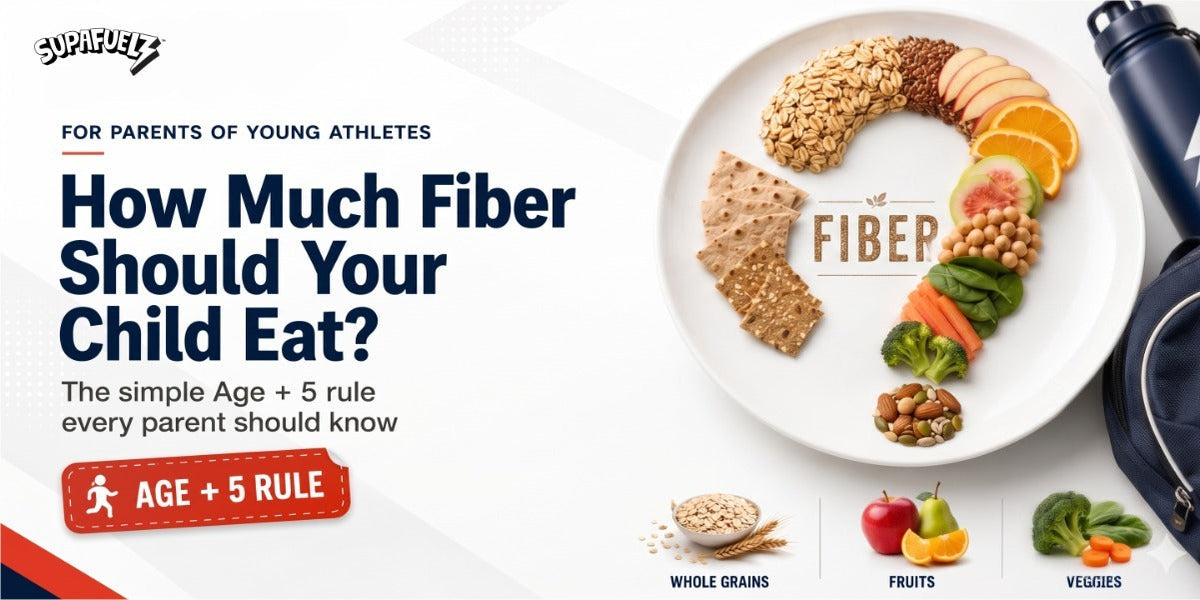
The Simple Age + 5 Rule Every Parent Should Know
You probably think often about your child's protein, calcium, vitamins, and growth nutrition. But here's a question many parents overlook: Is my child getting enough fiber?
You don't need a complicated calculator. There's a simple rule: Age + 5.
According to the American Academy of Paediatrics (AAP), children should consume their age in years + 5 grams of fiber daily.
How it works:
5-year-old → 10g/day
7-year-old → 12g/day
10-year-old → 15g/day
12-year-old → 17g/day
15-year-old → 20g/day
18-year-old → 23g/day
One number. One practical target
Why Fiber Matters (More Than You Think)
✓ Healthy digestion and regular bowel movements
✓ Beneficial gut bacteria
✓ Steady energy levels
✓ Better diet quality
✓ Long-term metabolic health
For active kids and young athletes, fiber-rich foods also deliver vitamins, minerals, antioxidants, and plant compounds that support recovery.
The Gut: Your Child's Hidden Performance Partner
Trillions of beneficial bacteria live in your child's digestive system. They support digestion, immunity, and overall health. What do they eat? Fiber.
Scientists call fiber "food for the gut microbiome" because it feeds beneficial bacteria. When children eat fruits, vegetables, whole grains, legumes, nuts, and seeds, they're feeding the gut ecosystem that keeps them healthy.
What Research Shows
Paediatrics (2015): Children meeting fiber recommendations had higher intakes of vitamin D, calcium, magnesium, and iron.
Nutrition Journal (4,747 Indian school children, ages 3–18): Adequate protein and fiber-rich diets support better growth and body composition.
ICMR-NIN: Emphasizes fruits, vegetables, whole grains, legumes, and millets as essential parts of a balanced diet for Indian children.
The Encouraging News?
Traditional Indian meals already contain many naturally fiber-rich foods. Sometimes it's simply about choosing them more often. However, if replaced with its more processed version the fiber gets thrown out.
The Indian Advantage: Fiber Foods You Already Have

Whole Grains & Millets: Whole wheat flour, ragi, jowar, bajra, oats, brown rice
Pulses & Legumes: Dal, rajma, chana, green peas, soybeans
Fruits: Guava, apple (with skin), pear, orange, banana
Vegetables: Carrot, beetroot, spinach, broccoli, green beans
Nuts & Seeds: Almonds, walnuts, flax seeds, chia seeds, pumpkin seeds
These are everyday foods—not fancy health foods.
Simple Ways to Add More Fiber
Breakfast: Oats instead of sugary cereal | Fruit with breakfast | Ragi porridge
Lunch: Extra vegetables in dal | Whole wheat roti or brown rice | Add salad | Include legumes regularly
Snacks: Fruit instead of packaged snacks | Roasted chana | Nuts and seeds | Homemade trail mix
Dinner: Vegetable-rich meals | Whole grains whenever possible
Important Tips
Increase Gradually: If your child eats little fiber, add it slowly over a few weeks. Too much too fast causes bloating.
Water Matters: Fiber works best with adequate hydration. Encourage regular water intake.
Food First: Whole foods provide fiber plus vitamins, minerals, antioxidants, and beneficial compounds. Food is the preferred source.
What Parents Can Do
✓ Prioritize whole, minimally processed foods
✓ Focus on variety over perfection
✓ Make fiber-rich foods part of family meals
The Bottom Line
Fiber plays a bigger role in children's health than most parents realize. Healthy gut, steady energy, regular digestion, and better diet quality start with enough fiber on the plate.
Next time you wonder if your child is getting enough fiber, remember: Age + 5.
One simple number. One practical goal. One easy way to support your child's healthy growth journey.
References
Paediatrics. Dietary Fiber Intake and Nutrition Status in Children (2015)
https://pubmed.ncbi.nlm.nih.gov/25624364/
Nutrition Journal. Impact of dietary nutrient intake on growth in urban Indian school children (2018)
https://pubmed.ncbi.nlm.nih.gov/29278646/
American Academy of Paediatrics (AAP). Increasing Fiber Intake During Childhood and Adolescence (2021)
https://extension.usu.edu/nutrition/research/increasing_fiber_intake_during_Childhood_adolescence
Canadian Paediatric Society. The Role of Dietary Fibre and Prebiotics in the Paediatric Diet (2020)
https://cps.ca/en/documents/position/the-role-of-dietary-fibre-and-prebiotics-in-the-paediatric-diet



Leave a comment
This site is protected by hCaptcha and the hCaptcha Privacy Policy and Terms of Service apply.