
What Young Athletes Are Saying to Themselves
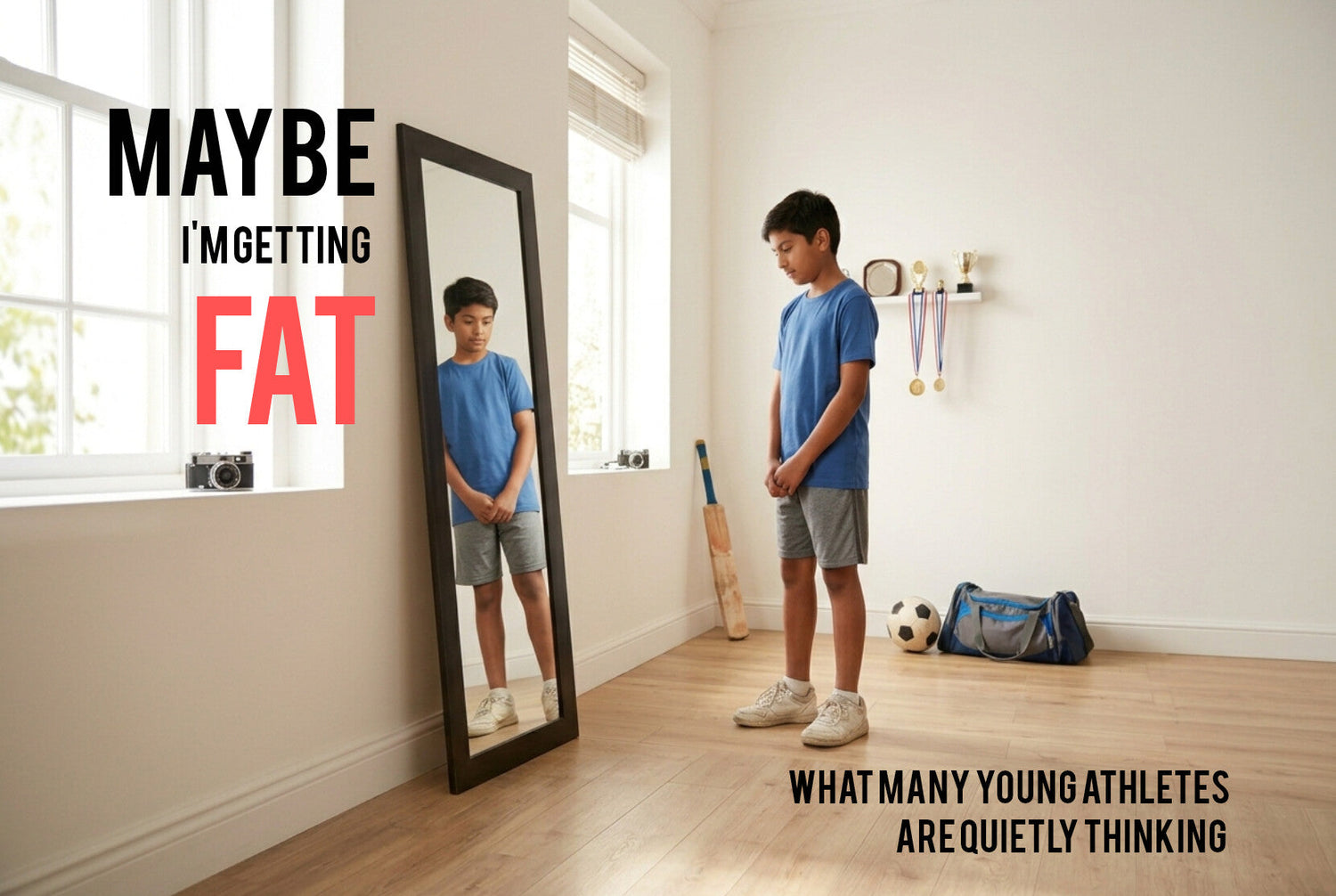
When a sporty child's body starts changing — stronger legs, broader shoulders, a bigger appetite — they don't always understand what's happening. Instead of connecting these changes to healthy growth and training, many jump to worry.
"Mom… do I look fat?" · "I should stop eating rice." · "I think I'm eating too much." · "My stomach looks bigger." · "Will my teammates notice if I take seconds?"
These thoughts are the early signs of body image concern — and research shows they are increasingly common among young athletes today. ¹
Body image dissatisfaction happens when young athletes start perceiving their bodies negatively — even when they are healthy, growing, and performing well.
Here's the truth: Many of the physical changes young athletes experience are completely normal. Muscle development, puberty, growing appetites, clothes fitting differently — these are signs of a body doing exactly what it should. But without the right context and support, children can misread them entirely.
Why This Matters More Than We Think
Body image concerns aren't just about feelings — they have real consequences for a child's health, sport participation, and long-term relationship with food.
45% of female youth athletes leave sport due to body image concerns (Sport Wales)
17.6% of Indian athletes in weight-category sports show signs of disordered eating (African Journal of Biomedical Research, 2025)
70% of teen athletes spend 2+ hours/day on Instagram or TikTok, comparing bodies (Yagin & Flucus, 2025)
5–33% prevalence of eating disorders among young athletes vs. 2.3% in general population (Marrows et al., JSAMS Plus, 2023)
These numbers aren't meant to alarm — they're meant to inform. The earlier parents recognise what's happening, the easier it is to address.
Why Is This So Common in Indian Athletes?
1. Societal Pressure on Bodies
A 2025 study of girl athletes in New Delhi found that body image concerns were a significant barrier to sport participation. Girls reported societal pressure about how a female body "should" look, harassment both on and off the field, and the weight of family expectations around appearance. The study's central finding? "Change needs to start at home." ¹
2. Sport-Specific Pressure
Certain sports carry particular body pressures. In aesthetic sports like gymnastics and dance, the message is often "be lean." In weight-category sports like wrestling and boxing, athletes face pressure to "make weight." In endurance sports, there's a common but mistaken belief that "thinner = faster." All of these can push young athletes toward restricting food — even when they need more of it.
3. Social Media Amplification
A 2025 study of 45 teen athletes found that 40% had experienced cyberbullying about their physique, and 35% had edited photos to meet athletic body standards. ³ Female athletes tended toward dietary restriction; male athletes faced pressure around muscle gain. The images young athletes scroll through every day are rarely realistic — and rarely reflect the full diversity of athletic bodies.
4. The "Eating Healthy" Trap
Some young athletes who are most motivated to perform well actually restrict too much — cutting carbs, skipping meals, following adult diets — believing it will make them faster or lighter. In reality, rigid restriction increases the risk of disordered eating and hurts performance. ⁶
The "Second Serving" Guilt
One of the quietest and most common signs is a child who stops asking for more food. Not because they aren't hungry, but because they feel guilty. They've heard things like:
✗ "Don't eat too much." ✗ "Carbs make you fat." ✗ "Athletes should stay lean." ✗ "You're eating again?"
Words like these stay with children far longer than adults realise. Over time, they can turn food into something stressful rather than nourishing.
Warning Signs to Watch For

These signs may appear gradually, which is why they're easy to miss. ⁵
🔴 Behavioural Signs
● Skips meals regularly, especially around practice
● Avoids weighing themselves, or checks weight multiple times a day
● Has rigid food rules — avoids entire food groups without medical reason
● Exercises excessively beyond their sport requirements
● Withdraws from teammates or social situations around food
● Becomes obsessive about calories, macros, or "clean eating"
🟡 Physical Signs
● Persistent low energy, poor coordination, slower recovery
● More frequent injuries than usual
● Unexplained weight or muscle loss
● Missed or irregular periods in teenage girls
● Dizziness, sensitivity to cold, hair loss
🟠 Emotional Signs
● Anxiety or distress around mealtimes
● Increased irritability, withdrawal, or mood swings
● Self-worth tied entirely to athletic performance or appearance
● Perfectionism that's getting harder to manage
Signs adapted from McTiernan, Kids Mental Health Foundation, 2025. ⁵ If you notice several of these signs together and they persist, speaking with a paediatrician or registered dietitian is a good first step.
What You Can Do as a Parent
The good news: parents have enormous influence here — and it doesn't take dramatic conversations. Small, consistent shifts in language and approach make the biggest difference.
💬 Try Shifting the Conversation
|
Instead of saying… |
Try saying… |
|
"Are you eating too much?" |
"Did you eat enough before practice?" |
|
"Careful, you might be getting fat." |
"How was your energy in training today?" |
|
"That's too much rice." |
"Are you recovering well after practice?" |
|
"Athletes should stay lean." |
"Strong athletes eat well and rest well." |
Other things that help:
● Praise effort, skill, and character — not appearance or weight
● Model a healthy relationship with your own food and body
● Talk openly about the body changes that come with puberty and sport — normalise them
● Avoid labelling foods as "good" or "bad" — food is fuel and enjoyment
● Create a home environment where eating enough is celebrated, not questioned
Helping Your Child Think About Their Body Differentl
One of the most powerful reframes you can offer a young athlete is this simple shift:
Instead of: "How does my body look?"
Encourage your child to ask: "Am I valuing my body for what it can do — not just how it looks?" ⁵ This shift from appearance to function can genuinely change how a young athlete relates to training, food, and themselves.
"Maybe I'm getting fat" is often a call for reassurance — not a fact about the body. The right response from a parent can change everything.
"If you're a young person reading this and recognise some of these feelings in yourself, please talk to a trusted adult, your coach, or a doctor — you don't have to figure this out alone. Vandrevala Foundation helpline: 1860-2662-345 (24/7)
References
-
Budhraja M, et al. Body image in girl athletes and coaches in New Delhi, India. Psychol Sport Exerc. 2025
🔗 https://www.sciencedirect.com/journal/psychology-of-sport-and-exercise - Dr Aarti, et al. Disordered eating in Indian athletes. African J Biomed Res. 2025🔗 https://www.ajbr.org/
- Kmanpub. Social media and body image in teen athletes. 2025🔗 https://kmanpub.com/
- Cardiff University. Body image dissatisfaction in young athletes. 2021🔗https://www.cardiff.ac.uk/news/view/1934367-body-image-dissatisfaction-in-young-athletes
- Kids Mental Health Foundation. Healthy body image in student-athletes. 2025🔗https://kidsmentalhealth.org/healthy-body-image-in-student-athletes/
- Stanford Children's Health. Eating disorders and young athletes. 2024🔗https://www.stanfordchildrens.org/en/topic/default?id=eating-disorders-and-young-athletes-906-P01234
- Sport Wales. Body image pressure affecting young athletes. 2026🔗 https://www.sportwales.org.uk/news/body-image-pressure-affecting-young-athletes/
- LinkedIn. Mental health in young Indian athletes.2024🔗 https://www.linkedin.com/
- Thomas DT, Erdman KA, Burke LM. Position of the Academy of Nutrition and Dietetics, Dietitians of Canada, and the American College of Sports Medicine: Nutrition and Athletic Performance. Journal of the Academy of Nutrition and Dietetics. 2016;116(3):501–528.🔗 https://doi.org/10.1016/j.jand.2015.12.006
- Mountjoy M, Sundgot-Borgen J, Burke L, et al. IOC Consensus Statement on Relative Energy Deficiency in Sport (RED-S): 2018 Update. British Journal of Sports Medicine. 2018;52:687–697.
🔗 https://bjsm.bmj.com/content/52/11/687 - American Academy of Pediatrics Committee on Nutrition and Council on Sports Medicine and Fitness. Sports Drinks and Energy Drinks for Children and Adolescents: Are They Appropriate? Pediatrics. 2011;127(6):1182–1189.
🔗 https://publications.aap.org/pediatrics/article/127/6/1182/30044 - Rosen DS, American Academy of Pediatrics Committee on Adolescence. Identification and Management of Eating Disorders in Children and Adolescents. Pediatrics. 2010;126(6):1240–1253.
🔗 https://publications.aap.org/pediatrics/article/126/6/1240/65015 - HealthyChildren.org (American Academy of Pediatrics). Helping Teens Develop a Healthy Body Image. HealthyChildren.org🔗 https://www.healthychildren.org/welcoming/articles-helping-teens-develop-a-healthy-body-image
- Indian Council of Medical Research (ICMR-NIN). Dietary Guidelines for Indians.ICMR-NIN🔗 https://www.in.nin.res.in/dietaryguidelines.html

Leave a comment
This site is protected by hCaptcha and the hCaptcha Privacy Policy and Terms of Service apply.